RAWA: The VOICE of the VOICELESS
A
full color booklet with over 350 photos from different RAWA activities in
Afghanistan and Pakistan.
Book
shows Afghan women's covert struggle
Subhuman
treatment spawned group whose founder was assassinated
By Lori Shontz,
Post-Gazette Staff Writer
a
review of With All Our Strength
The candle of Afghanistan’s modern Dark Ages An independent review of Anne E. Brodsky’s first hand account of the
Revolutionary Association of the Women of Afghanistan‘With All Our Strength’ – Published June 2003, Routledge
The aftermath of 11 September forced the world to fully realise that terrible atrocities had long been taking place in Afghanistan, and that for equally as long little real help of intervention had been forthcoming from the outside world. Western governments chose to look away through the turmoil years of brutal civil war, the Soviet invasion and 10 years of resistance, the Taliban.
Formed in 1977 and undeterred from their evolving goals despite the assassination in 1988 of their founder leader known simply as Meena, a relatively small underground group of dedicated women calling themselves the Revolutionary Association of the Women of Afghanistan continued risking their own, and sometimes the lives of their family members and friends, to spread the message of equality of human rights and secular democraticfreedom, and to deliver education among their people in a struggle almost unseen by the wider world. And all this in a country where education for girls aged over eight became outlawed under Taliban rule.
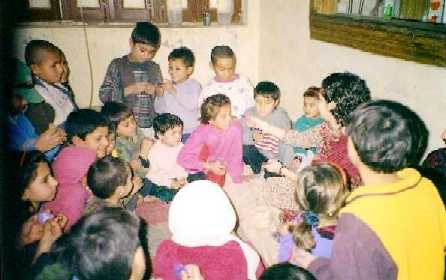
Anne Brodsky handing small toys to children at a RAWA orphanage outside of Rawalpindi Pakistan in December 2002Almost unseen, until 11 September.
Revolutionary and underground resistance groups have existed since the dawn of society. Only very few through history have grown from national to international prominence and effect. Few if any of those who resorted to the use of arms or violent means to achieve their aims survived intact in the longer term to pursue those aims. Others, who refused to regress to violence, gradually vanished as the need for their existence diminished — yet others have been brutally and ruthlessly crushed by the oppressors against whom they struggled.
With All Our Strength, Anne E. Brodsky’s impassioned firsthand account of the Revolutionary Association of the Women of Afghanistan, stands as a key literary cornerstone in documenting the need for a greater awareness of an all-embracing approach towards change for any true betterment and progress within society. It is a tale of triumph and perseverance against the tragedies of brutal oppression.
It recounts the stories of a people, whose choice of a hugely difficult and dangerous lifestyle we in the West would say calls for constant utmost dedication and bravery, but which RAWA supporters simply see as what needs to be done.
From her independent perspective gleaned through conversations with many RAWA members and supporters, who were and still are forced to operate in high measures of bravery and secrecy, Anne Brodsky’s impassioned account warns of the potential dangers in steadfastly holding to accepted values and in refusing to sanction the possibilities achievable through enlightened change.
With All Our Strength portrays how the Internet can be of immense benefit. It was not until 1997 that RAWA was able to access the web and to create their own web site (www.rawa.org) and that elevated their relative isolation from the rest of the world to a far broader international awareness.
A community psychologist and assistant Professor in the Department of Psychology and the Women’s Studies Programme at the University of Maryland Baltimore County, Anne Brodsky compiled her account after meeting, living and working with RAWA members and supporters in Pakistan and Afghanistan
It pulls focus on the accepted and acceptable organisation and structure of society the world over – from gender separation in educational systems that are geared towards material or financial profits to the very real and continuing prejudice and discrimination caused by inadequate education and non-secular rule.
It reveals why people cannot afford to ignore the poisonous seeds of unintentional or deliberate oppression within their midst, for to do so will only result in them later reaping the poisoned fruit of those seeds with each harvest.
It records the widespread disquiet that continues to be voiced within Afghanistan as, even after the US led military removal of the Taliban, brutal Northern Alliance warlords who were themselves guilty of atrocities prior to Taliban rule are reinstated to power in parts of the country.
Everybody should read this book. It is a vital piece of the jigsaw of progress towards freedom and equality the world over. Yet for a book such as this to have true impact, any misconceptions born of prejudice must first be set aside.
The book explores feminist separatism as viewed through the eyes of both female and male RAWA members and supporters. It examines the views of Afghanistan men towards male domination — men who were brought up in an environment where male domination, often ruthlessly enforced, was widely viewed as the norm.
Of particular note are the recorded thoughts and comments of men who were once themselves members of the Taliban or Northern Alliance and who admit to having participated in atrocities with those regimes, but who have relinquished their old ways to become supporters of and accepted by RAWA—a complete role reversal on the part of such men.
The foreword to the book, penned by RAWA, reads:
"...even as September 11 suddenly brought the world’s largest forgotten tragedy to the centre of attention, still most people and governments and media do not understand our reality. The tragedy of our country has been reduced to the image of the Taliban and the burka and a narrow 5-year period of our history…"
The world is a changing place. The ever-present threat to life encouraged the sense of human selfishness to prevail – self preservation. The reality of the need to survive against violent odds has been reduced by the developments of people everywhere — yet the individual perception of the true reality of the need to survive against violent odds has not changed much at all in many people in many parts of the world. Ill-conceived perception still drives many of us and it is clear that root causes must be tackled to remove repressive negative attitudes towards change.
Anne E. Brodky’s penetrating and meticulously compiled book documents how RAWA has built itself upon the core principle of tackling such root cause.
This is a multi-faceted book that everyone should have the opportunity to read — those working for changes in civil or human rights, those working in or on behalf of government, and the ordinary individual at home. It is also an important book for all involved in the reporting industry as it records how the media stood back from on-going human atrocities in the world.
It is the hopes and aspirations of so many within Afghanistan who have found the courage to fight against terrible oppression. It is a witness to male insecurity and the dangers such insecurity can produce if not addressed.
"The work of RAWA must stand as a model for every group that struggles against the twin evils of oppression and violence. Brodsky’s account reveals the boundless courage of these warrior women, who have fought for basic human dignity while the rest of the world looked away."
— Eve Kensler, author of The Vagina Monologues – sleeve noteWith All Our Strength is a moving and biting portrayal of the remarkable bravery and resilience of Afghanistan’s people, led by women in a country that has traditionally oppressed women and has seen some of the most brutal abuses of human rights of the last thirty years.
RAWA began as a lone candle flickering in a dark night fighting to stay alight against a storm. Anne Brodksy’s book presents that flame to the world and thus helps ensure that it is nurtured and its light seen beyond the darkness within Afghanistan.
The author is donating her proceeds from the sale of the book to RAWA.
ORDER DETAILS PLUS AN ON-LINE LINK TO AMAZON
- profits from using the Amazon link go to RAWA
![]()
With All Our Strength is published by Routledge, New York & London (hardback)
[published June 2003]
US $25.00
UK £14.99ISBN: 0-41593492-3
Interviews with Anne Brodsky may be arranged through Aine Duffy: +44 (0) 207 842 2117
review compiled by keith harris
The Revolutionary Association of the Women of Afghanistan
Mailing Address: RAWA, P.O.Box 374, Quetta, Pakistan
Mobile: 0092-300-8551638
Fax: 001-760-2819855
E-mail: rawa@rawa.org
Home Page: http://www.rawa.org
Mirror site: http://rawa.fancymarketing.net
Latest from Afghanistan ![]()
ON
THIS PAGE or archived on this site
The
NATO Occupation and Fundamentalism—An interview with Mariam of RAWA
Afghan
journalists seek release of colleague
Keep
the Light of Hope Alive—Support RAWA's Orphanage Program
The
US and Her Fundamentalist Stooges are the Main Human Rights Violators in
Afghanistan
Afghan
parliamentarians: "Women prisoners are raped in a Kabul prison"
Stop
Human Catastrophe: Help Afghan Refugees!
Afghanistan:
Reinstate MP Suspended for 'Insult'
Afghan
assembly grants immunity for war crimes
Keeping
the Light of Hope Alive (from 2006)
RAWA
communiqué on Universal Human Rights Day, Dec.10, 2006
Warlords
gang-rape a woman in Badakhshan
Post-Taliban
Kabul blossoms for the rich
Meena
among 60 Asian Heroes of Time Magazine
Sanobar,
11-years-old girl is abducted and raped by warlords
90
civilians perish in NATO air strike: Residents
Afghan
women call for ousting war criminals
Karzai offers olive branch to Taliban
Protest
against warlords sway in Afghanistan
Hezb-e-Islami
of Gulbuddin Hekmatyar has 34 members in the lower house of parliament
RAWA
appeal for Child Sponsorship Program & New Orphanages
The
women of Afghanistan find a leader
Photo
exhibition of war-torn Bosnia and Afghanistan
Afghanistan:
Bring War Criminals to Justice
Hope
lives on...By Erica
Ahmed
Afghanistan:
A Harvest Of Despair
Afghan
big freeze proves deadly
RAWA
starts 2005 with an appeal for help
‘No
warlords in Afghan cabinet’
Letter
From Afghanistan — Painful story of the Herati shelter
girls
Advocates
Say More Improvements Needed for Afghan Women
A
Threatened Afghanistan
Certificate
of Special Congressional Recognition Presented to RAWA
War
Returns with a Vengeance as Allies Fail the Afghan People
Latest
from RAWA Gloom of 28th April still dominant in Afghanistan
Afghan
province bans women performers on TV, radio
AI
ask international community to uphold its human rights responsibilities
RAWA
Receives the 20th International Alfonso Comín Award
A
Benefit compilation for RAWA produced by Steve Tobin
honorary doctorate for meritorious service to society
Magazine, August 14, 2008
The NATO Occupation and Fundamentalism
An interview with Mariam of RAWA
By Justin PodurISLAMABAD - The Revolutionary Association of the Women of Afghanistan (RAWA) is a women's organization that runs underground schools and other projects, educates Afghan girls, runs a periodic journal, and agitates politically for women's rights, human rights, secularism, and social justice in Afghanistan. From the 1979 Soviet invasion through to the 2006 closings of the camps, millions of Afghan refugees lived in Pakistan and many still do. While RAWA's operations were always based primarily in Afghanistan, they have also had a strong presence in the Pakistan refugee community. I spoke to Mariam from RAWA in Islamabad when I was there in July 2008.
JUSTIN PODUR (JP): To begin, perhaps you could introduce readers to RAWA and its work in Afghanistan and Pakistan.
MARIAM (RAWA): RAWA was begun in 1977 in Kabul as an organization of Afghan women for human rights and women's equality. After the Soviet invasion, some RAWA members were imprisoned in Kabul, and as a huge number of refugees fled to Pakistan, RAWA also shifted its focus somewhat, and began to work with refugee women and children in Peshawar (the capital city of the North West Frontier Province in Pakistan, close to the Afghan border). We began providing humanitarian services and some social assistance, through which we also tried to educate Afghan women of their rights. We continued our political activities, but because of the security situation in Afghanistan it was not easy. We continued to work underground in some Afghan cities. When the Soviet occupation was followed by the fundamentalists' bloody rule and later the Taliban regime, we continued to work both in Afghanistan and Pakistan. We ran literacy programs, orphanages and schools in Afghanistan, but a lot of o! ur public, political statements were made from Pakistan. We publish a political magazine called Payam-e-Zan (Women's Message). Today under the NATO occupation and after the closing of the refugee camps, we do the political part mostly from Afghanistan as well, but much of our work is still semi-underground due to grave security risks.
JP: Can you say something about how RAWA is organized, how you 'recruit', where RAWA's leaders are drawn from?
RAWA: Through our literacy programs, orphanages, and schools, RAWA has had contact with many girls over the past 15-20 years. There is a deep difference between the life of women in Afghan society who have lived through war, the Taliban, and the fundamentalists, in normal domestic life, and those girls that have been basically raised by or worked with RAWA. The latter have different vision, ideas, and mentality; they are aware of their rights and know that they must fight to achieve it. Some of them continue to work for RAWA after they are grown up. Some are adult women when they get involved and their whole families get involved. Some young girls and boys get involved. Others are involved who don't yet read and write but become attached to RAWA, especially in rural areas, where RAWA members live and work and are part of the community with the people.
JP: And what is the situation of Afghan refugees in Pakistan today?
RAWA: In general, Pakistan has been better to Afghan refugees compared to Iran or other neighboring countries. There have been some limits. The life in refugee camps was very hard and with very basic resources. The majority of the camps were under the control of fundamentalist parties who imposed their restrictions on the refugees. Work for democratic-minded groups such as RAWA was very hard and risky. Many Afghan freedom-loving individuals were assassinated by Jehadi groups with the help of Pakistani ISI. Meena, RAWA's founder, was one of them. But despite all the problems, RAWA had its presence in some of the camps and we were running a refugee camp in suburbs of Peshawar for over two decades until it was finally forcibly evacuated by the Pakistan government some months ago.
In 2001-2002, after the US invasion and occupation, large numbers of Afghans went back. The Peshawar refugee communities were basically emptied, but due to bad conditions, returning to Afghanistan is still an unattractive option for many refugees.
When the government decided to close some refugee camps in 2006, it had a huge effect. Most of the refugees were forced to leave, even though they had lost everything in Afghanistan: they had no jobs, no shelter, nothing to go back to. And in fact no one knows what happened to them. Those families who have returned to Afghanistan are very disappointed with the lack of any job and facilities in Afghanistan, and many came back to seek refuge to Pakistan for the second time.
Today according to the UNHCR, refugees are coming back to Pakistan and they are trying to find places in the cities. When there is any tension between the Afghanistan and Pakistan governments, the Afghan refugees who suffer the most. Pakistan puts pressure on refugees to return to Afghanistan. But the people in the border areas are the same people - they share language, culture, clothing, tradition. After thirty years, too, many refugees saw Pakistan as their second country. Afghans know Pakistan supports the Taliban and the fundamentalists in Afghanistan, but the political crisis won't weaken the relations of the people across the border.
JP: Perhaps we could complete the introduction with a bit of your analysis of the political and military situation in Afghanistan.
RAWA: It is a complicated situation. We have NATO's occupation and the interference of neighbors, Pakistan, Iran, Saudi Arabia, Tajikistan, Russia etc. all of whom have supported different fundamentalist groups in recent years. The Taliban control some areas and in recent months even reached the borders of Kabul. They are being supported by some circles in Pakistan. Even the Iranian regime sends arms and ammunition to the Taliban. Afghan civilians are the prime victims of Taliban brutalities, again, including their suicide bombings. The brothers-in-creed of the Taliban, the Northern Alliance, are in power today and generously supported by the US government. Much of the northern part of Afghanistan is ruled by the local warlords of the northern alliance. The government of Hamid Karzai has no tangible control there. The Taliban and other Islamic movements are the enemy of the Afghan people. And their strength is supported by the US and the West. The support the fundamen! talists get from outside makes it difficult for the Afghan people to resist them. On the other hand the US/NATO play a Tom and Jerry game with the Taliban and Al-Qaeda, while ordinary Afghans severely suffer from the impact of their blind bombardments and we witness awful tragedies of civilian casualties on a daily basis.
JP: You have described all of these Islamic political movements as enemies of the people, whether they are supported by the West or fighting NATO. I have heard the argument here that Pakistan and Afghanistan are deeply religious countries, and any political movement has to contend with that fact. As a consequence, I have heard that groups like RAWA isolate themselves because of their uncompromising stand on secularism and religion. Do you find that your secularism makes you unpopular?
RAWA: That is the impression the Western media give of Afghan society. Maybe it is true from their eye. We Afghans have lived through it. How it expresses itself depends on many factors, including social, cultural, and economic factors. We have worked in some of what would be called the most 'backward' areas, very religious, without much recognition of women's rights. But after some time, and sometimes it is quite quickly, over weeks or months, they come to like what we are doing and even get involved, even whole families. We have seen this in some areas. So I do not agree that the country as a whole couldn't accept democratic rights or secular values. It needs time and work to build social and political awareness, and in recent years people have not had that opportunity.
The brand of Islam the fundamentalists present is different from that of common Afghan people. Their Islam is a political Islam and each party has their own brand, which contradict each other. The Islam of Mullah Omar is different from the Islam of Burhanuddin Rabbani or Rasul Sayyaf, and these groups have been at war for years although they all pretend to be true Muslims. The fundamentalist groups have committed unprecedented crimes under the name of Islam over the past two decades. Today Afghans are so fed up with them that majority of Afghans support any voice raised against the fundamentalists. When Malalai Joya spoke against them for only 2 minutes in the Loya Jirga, her voice was soon echoed and supported by millions of Afghan across the country and she was called a heroine and voice of the voiceless. The fundamentalists impose their domination with the help of their weapons, foreign masters and money. Without these, they have no footing in Afghan society.
JP: Is the NATO' occupation helping or harming Afghanistan? Can it be used somehow to strengthen progressive forces? Is it holding back a Taliban victory which would be worse than the current situation?
RAWA: Seven years ago when the US invaded, the situation was different. Many Afghans appreciated their presence and were happy to get rid of the Taliban's oppressive rule. They thought - the Taliban had been eliminated, the international community worked, they were promised a better life, democracy and freedom and an end to the fundamentalist groups. Within months, it was clear that the US government still continues its wrong policy of supporting the fundamentalists in Afghanistan. We saw that the US rely on the fundamentalists of the Northern Alliance to fight another fundamentalist band - the Taliban. It doesn't matter if they fight the Taliban or "terrorism", they are supporting the Northern Alliance, and for Afghans both are the same - both are terrorists and fundamentalists, supported by foreign governments, whether by the West, or Pakistan, Iran, Saudi Arabia or any other country. They violate human rights, they abuse women, they commit corruption and fraud and ! smuggling, as we have documented.
From the beginning, RAWA announced that the US and the West have their own reasons for being here and it is not for the freedom of the Afghan people. We said that what the US/NATO is doing under the name of democracy is in fact a mockery of democracy. It is clear for us. Today NATO bombings are increasing, more civilians are being killed, and other violations are being done by the US and NATO. And now even they are trying to share power with the Taliban and terrorist party of Gulbuddin Hekmatyar. If this plot is realized, it will mean another tragedy for Afghanistan and its people, the unification of all enemies of Afghan people under one umbrella so they could jointly smash the Afghan people and freedom-loving individuals and forces.
Under the mafia system and the shadow of gun and warlordism, unfortunately there is no chance for progressive forces to come to the scene and work openly. Any serious and stanch anti-fundamentalist and anti-occupation force still needs to fight underground and they are not supported and encouraged. In fact the US is afraid to see emergence of a powerful progressive movement in Afghanistan. Those who openly criticize the government and warlords face threats, imprisonment and restrictions. We are facing the same problems and risks today which we were faced under the Taliban.
The privatization and the free market system imposed on Afghanistan since 2001 is opening the way for neoliberalism in Afghanistan, which is another nightmare for our people. We are feelings its disastrous impact on poor people of Afghanistan. The degree of destitution and poverty in Afghanistan is beyond imagination. The gap between rich and poor is getting wider day by day. Over 70% of Afghan people are living under the poverty line. According to official statistics, 42% are living with only US$10/month. Skyrocketing prices in recent months have made life a torture for the majority of Afghan people.
JP: What about the argument that if NATO left, Afghanistan would quickly fall to the Taliban, which would be worse?
RAWA: It is true that it might be worse under a Taliban regime. But at least we will not be occupied by a foreign power. Today we have two problems: our own local fundamentalists and a foreign occupier. If NATO left we would have one problem rather than two.
RAWA has announced a number of times that neither the US nor any other power wants to release Afghan people from the fetters of the fundamentalists. Afghanistan's freedom can be achieved by Afghan people themselves. Relying on one enemy to defeat another is a wrong policy which has just tightened the grip of the Northern Alliance and their masters on the neck of our nation.
JP: If NATO left the Taliban would also have a more difficult time portraying themselves as a national liberation movement, an argument they can make and a source of prestige for them so long as the occupation continues.
RAWA: Actually both parties depend on each other. If the US were to eliminate the Taliban somehow, they would find themselves with no pretext for being here. But the Taliban and terrorism are only a pretext. They are not honest. They are here for the strategic ends: the central location from which to control Iran, Russia and China, affect Pakistan's government and society, strengthen its grip on the Central Asian Republics and so on. That is why they keep increasing their military presence and building up bases. NATO will probably leave, but the US won't - they wanted a pretext for being here, and the US will not set aside the golden opportunity.
JP: NATO's "development effort" has involved a lot of non-governmental organizations (NGOs) that have been involved in providing social services. Is RAWA seen as one of these?
RAWA: RAWA never introduces itself as an NGO. It is a political organization for women's rights and human rights. But it does try to meet direct needs and we do run social programs. Actually it is our political stance and activities that hurt our relations with the NGOs and agencies and why we don't get funds from foreign governments. Embassies do not want to give RAWA funds because we are political. This is in contrast to the thousands of recently established NGOs in Afghanistan over the past 6-7 years. It is a good business. You will have some families, with some English and a computer, and they become an NGO with funds, documents, and proposals being produced in their homes. Most NGOs that are larger, or bigger aid agencies, are funded by governments and influenced by those governments. The smaller ones often get involved in fraud and corruption - they work not for the Afghan people but for their own purposes. Millions of dollars of funds go to NGOs and are wasted ! in overhead, salaries, office expenses, and so on. They collect huge salaries, they have no long-term projects, they spend huge amounts for security expenses and vehicles.
NGO-ism is a policy exercised by the West in Afghanistan; it is not the wish of the Afghan people. The NGO is a good tool to divert people and especially intellectuals from struggle against occupation. NGOs defuse political anger and turn people into dependent beggars. In Afghanistan people say, the US pushed us from Talibanism to NGO-ism!
JP: Your political stance means governments don't want to give you money. Do you have any criteria for where you will accept donations?
RAWA: The question has not come up since we have not been offered funds from a government. But we will accept unconditional support from any source. We rely on individuals and sometimes, groups of feminists in other countries who support RAWA. We sell our own materials through income-generating projects, carpets, handicrafts, CDs, posters; we do fundraising whenever we go on speaking tours to other countries. That is how we continue. After 9/11 there was some interest in RAWA and we had good funding for 1-2 years. Today Afghanistan has the same problems but we have had to scale back our operations, reduce the numbers of children in our orphanages, and cancel some projects for lack of funding. RAWA is facing a grave financial problems today which affects the scales of our activities.
We see a total difference between the Western governments and their people. Most of these people are not in favor of the policies of their government towards Afghanistan. I have heard there is a free media in the US, but also that people do not know much about the outside world or the policies of their governments. RAWA is proud to receive donations from individuals, organizations, and groups not linked to governments, but not from government sources that would put pressure on RAWA. We would rather forego such money and attempts to control us. Even if we face problems, one hundred dollars from individuals gives us courage and lets us know we have support, in a way that thousands of dollars from a government agency would not.
JP: These projects RAWA runs, they must be underground as well?
RAWA: They are semi-underground but not the way we were under the Taliban. We are able to run education projects, and have meetings and gatherings in Afghanistan. But we are not registered with the government. Even if we were, we know they would try to stop us. We never use the title RAWA for our projects. People mostly know, but officially, we are not registered as RAWA - all run as private activities, initiatives, run by locals.
JP: The primary media source in Afghanistan is the radio. Is it possible for RAWA to get on the radio? What is RAWA's media strategy?
RAWA: It is not possible at the moment, partly because of the financial (although some supporters from Italy have suggested they could raise funds for it, in fact), but mainly because of the security problem. But we can use some other techniques to run a radio station if we were provided with the needed funds and equipment. We can run it without any sign of RAWA in it, but still in the current situation, we can't reflect our points of view as clearly and openly as we do through our web site and magazine, because if we do so, the next day the radio staff will be gunned down by the warlords.
JP: I read recently that Afghanistan and Pakistan has a growing number of opium addicts, including women, as a consequence of the war and displacement. Has RAWA come across this in its social service work?
RAWA: Out of the estimated 26 million population, over one million are addicted, which include even children and women, and the number are increasing.
Many people who are involved in poppy fields gradually become addicted: a mother working in the fields all day with health problems of her own, can't get her child to sleep or stop crying, she might give some to her child. There are many women in prisons today, and large numbers get addicted in prisons.
JP: What is RAWA's perspective on drugs?
RAWA: We think poppy cultivation in Afghanistan is part of the US regional strategy to control this third biggest global commodity (in cash terms). And it is not a new phenomenon, but has been a project of the CIA's covert operations in the region since the start of the Soviet-Afghan war in 80's. Today even the US/NATO encourage farmers to cultivate poppies. There are some reports that even the US troops have hand in the drug trafficking and the US government makes billions from the Afghan drug business. The UK military are negotiating deals with the Taliban on drugs, in Helmand.
Since 2001 the opium cultivation increased over 4,400%. Under the US/NATO, Afghanistan became world largest opium producer, which produces 93% of world opium. Those engage in the dirty business reach to the Afghan cabinet and even recently Mr. Karzai was accused by US officials of supporting the drug-dealers. His brother Wali Karzai leads the largest network of drugs in Kandahar. Gen. Daud, head of the counter-narcotics department of the interior ministry, himself is a famous drug-trafficker! Warlords in the Northern Afghanistan each control the route of drug-smuggling to the Central Asian Republics.
No one talks about this horrible aspect of the US occupation of Afghanistan. We are now living under a narco-state and drugs has already impacted Afghan people with horrible consequences.
JP: As a political organization, what is RAWA's relationship with political parties in Afghanistan?
RAWA has announced a number of times that neither the US nor any other power wants to release Afghan people from the fetters of the fundamentalists. Afghanistan's freedom can be achieved by Afghan people themselves.RAWA: We have good relations with some. But unfortunately most political groups, democratic groups, human rights, women's rights, and intellectuals are not active. Thirty years ago there were lots of activities of such groups, and RAWA was just one. After the Soviet invasion and the Northern Alliance, the Taliban and Pakistan, many activists were arrested, assassinated, or made to flee the country. Our founder, Meena, and many others, were killed here in Pakistan, in the killing grounds of the Russian puppets and elsewhere. The past 30 years, the progressive forces of Afghanistan faced many losses and were always under pressure. And today still they are being marginalized or neutralized by the NGO-ism policy.
So the most powerful forces on the political scene are fundamentalists or linked to them, representing them, and using their political positions to protect them. Movements of left groups and intellectuals have been greatly weakened. But there are many progressive and freedom-loving individuals around and we have a long way to go and unite them under a unified force. There are some small groups too and we are in touch with them. We have to support each other.
There has been some rather small resistance against the US/NATO and warlords in some parts of the country. If the US/NATO occupation and atrocities continue for long, there will be stronger resistance from Afghan people.
To donate to RAWA, see the Afghan Women's Mission.
RAWA's website is www.rawa.org.
Justin Podur is a writer and activist based in Toronto. He was in Pakistan in July 2008. His blog is www.killingtrain.com.
Source: http://www.zmag.org/znet/viewArticle/18429
RAWA Newsletter
Friday, 30 May, 20081. Afghan Man Dies of Hunger Along With his Wife
2. A Young Boy Committed Suicide in Kabul Due to Poverty
3. Refugees in new Afghan drugs crisis
4. Post-War Suicides May Exceed Combat Deaths, U.S. Says
5. Afghan teacher shot dead after condemning suicide bombings as un-Islamic
6. Drought and Hunger Kill Nine People in Northern Afghanistan
7. Innocent Civilians Killed and Imprisoned by US Forces in Helmand
8. 'Civilians the worst sufferers of Helmand operation'
9. HIV risk in war-torn Afghanistan high
10. Afghanistan: A Socio-Economically Irrelevant Space to be kept “Empty” through Least-Cost Military Means
11. Outspoken MP driven from Wolesi Jirga session
12. What the U.S. wants in Afghanistan
13. Alarming Rise of Suicides Among Afghan Women
1- Afghan Man Dies of Hunger Along With his Wife
PAN: 55-year old Gul Murad lived a life of poverty in the Zedori village with his wife Anar Gul and eight children. Gul Murad had not had food for four days and died. When the people were burying him his wife went unconscious. When she was being taken to the Mazar-e-Sharif Hospital for treatment, she died on the way. At first the people thought she had died of the sadness caused by her husband’s death but later found out that she too had not eaten anything for days and had died of hunger.
2- A Young Boy Committed Suicide in Kabul Due to Poverty
RAWA News: A young boy in Kabul committed suicide by eating 100 Phenobarbatone tablets. The neighbors said that he was the bread winner of a very large family and also had the responsibility of feeding his orphan nieces and nephews. One person said, “Because there were no jobs he was left unemployed. This is a major problem and our government has the responsibility to provide jobs for our youngsters."
3- Refugees in new Afghan drugs crisis
The Observer: Afghanistan, struggling with a huge indigenous drug problem, has a new crisis. Its drug treatment centres - particularly in the capital, Kabul - are being inundated by heroin-addicted former refugees, many forcibly expelled from neighbouring Iran and Pakistan. 'The biggest problem now is the returning addicts. It is a tsunami coming to this country,' Suliman said.
4- Post-War Suicides May Exceed Combat Deaths, U.S. Says
Bloomberg.com: The number of suicides among veterans of wars in Iraq and Afghanistan may exceed the combat death toll because of inadequate mental health care, the U.S. government's top psychiatric researcher said. Community mental health centers, hobbled by financial limits, haven't provided enough scientifically sound care, especially in rural areas, said Thomas Insel, director of the National Institute of Mental Health in Bethesda, Maryland.
5- Afghan teacher shot dead after condemning suicide bombings as un-Islamic
Mail Online: A teacher was shot to death in northern Afghanistan after he gave a speech condemning suicide bombings, it was revealed today. e spoke at a gathering of about 700 people, including the Kunduz governor, and was on his way home when he was killed, Khair Mohammad Subat said.
6- Drought and Hunger Kill Nine People in Northern Afghanistan
Tolo TV: Drought in Northern Afghanistan killed nine people in Samangan province. According to reports no welfare organizations inside or outside Afghanistan have helped these people as yet. Meanwhile, the local authorities have asked aid organizations and the authorities in the capital to pay serious attention to the families in this province or Northern Afghanistan will face huge disasters.
7- Innocent Civilians Killed and Imprisoned by US Forces in Helmand
Tolo TV: Some representatives of Helmand province in the Parliament say that military operations of the American forces have been taking place in this district in the past two weeks and the forces have also killed and imprisoned civilians. These representatives demanded serious attention from the government regarding the matter. The civilians in Garmsir District of Helmand Province are living in terrible conditions.
8- 'Civilians the worst sufferers of Helmand operation'
PAN: Two senators from Helmand told reporters in Kabul on Monday that many civilians were killed, wounded and displaced during the operation by NATO and Afghan forces. Haji Mahboob Garmsiri, a senator from the district, and Haji Sher Muhammad Akhunzada, head of the parliamentary committee for internal safety in the senate also from Helmand, said that the civilians were the worst sufferers in the operation.
9- HIV risk in war-torn Afghanistan high
Reuters: The prevalence of HIV is low in Afghanistan, but the potential risk factors for the spread of the disease remain high, the Public Health Ministry said on Monday. "But ... war, poverty, illiteracy, massive international and external displacement, the high level of poppy cultivation, drug trafficking and usage, the existence of commercial and unsafe sex, unsafe injection practices and blood transfusion are potential risk factors for its spread," the ministry said.
10- Afghanistan: A Socio-Economically Irrelevant Space to be kept “Empty” through Least-Cost Military Means
Marc W. Herold: The facts regarding Afghanistan’s revealed irrelevance to the United States (and a reluctant NATO) are visible to all who wish to look: on average for every $100 spent on military efforts in Afghanistan, a trifling $4.50 is budgeted (and an even smaller amount is disbursed) for so-called reconstruction efforts.
11- Outspoken MP driven from Wolesi Jirga session
PAN: An outspoken legislator was expelled from a session of the Wolesi Jirga, or lower house of parliament, for his strident criticism of proceedings and working of a committee, officials said here on Tuesday. Ramazan Bashar Dost, former minister planning minister, was ousted from a meeting of the Wolesi Jirga on grilling Emergency Committee members after he raised a series of objections to the absence of the bodys head, Vice-President Karim Khalili.
12- What the U.S. wants in Afghanistan
SocialistWorker.org: A U.S. Marine Corps general has decided not to bring criminal charges against two officers who led their unit on a March 2007 killing spree that left 19 Afghan civilians dead and 50 more wounded. By contrast, the U.S. media barely noticed. For its part, the New York Times featured an article on Afghanistan a few days later celebrating a "fierce battle" by a Marine unit that drove Taliban fighters outside of the southern town of Garmser. The article referenced last March's massacre--but not the Marines' decision not to press charges.
13- Alarming Rise of Suicides Among Afghan Women
VOA: Greater freedom for the women of Afghanistan was one of the promises of the 2001 U.S.-led invasion. U.S. and Afghan officials say there have been significant improvements, noting that some two million women and girls are now attending school, something that was forbidden under the extremist Taliban government. But despite Western efforts, many Afghan women say their lives have not improved significantly and an increasing number of women are committing suicide by burning themselves to death as a way to escape physical, sexual and psychological abuse. Mandy Clark reports from Kabul.
Reuters, January 12, 2008
Afghan journalists seek release of colleague
The 23-year-old Sayed Perwiz Kambakhsh, reporter of Jahan-e Naw daily paper and a journalism student at Balkh University in northern Afghanistan, was detained three months ago
By Tahir Qadiry
MAZAR-I-SHARIF, Afghanistan - Dozens of Afghan journalists and activists on Saturday sought the release of a journalist detained by security officials for allegedly making blasphemous comments.The 23-year-old Sayed Perwiz Kambakhsh, reporter of Jahan-e Naw daily paper and a journalism student at Balkh University in northern Afghanistan, was detained three months ago.
Kambakhsh was accused of mocking Islam and the holy book, the Koran, and for distributing an article which said Prophet Mohammad had ignored the rights of women.
Activists gathered outside at the Human Rights Commission's office in Mazar-i-Sharif, the provincial capital of Balkh, demanding the journalist's release.
Habibullah Habib, the head of Balkh University, said Kambakhsh was detained following accusations by his classmates and an investigation had begun.
Kambakhsh's brother, Sayed Yaqub Ibrahimi who is also a journalist, said the charges were false.
Security officials refused to comment on the matter.
Journalist Sayed Yaqub Ibrahimi says his brother Parwez has been jailed and threatened with death because of his own reporting on human rights violations in the north.
A leading journalist in northern Afghanistan says his brother has been imprisoned on false charges as a way of pre! ssuring him not to write articles critical of local officials and strongmen.
IWPR, Dec.9, 2007Blasphemy is punishable by death in Islam and Afghanistan is a deeply conservative Islamic country.
Since the ouster of Taliban's radical Islamic government in 2001, dozens of newspapers and other publications, some funded by foreigners, have sprung up in Afghanistan which is going throug! h an unprecedented wave of press freedom in its history.
Several years ago, two journalists were detained for making blasphemous comments, but the pair managed to escape and have been given asylum in a Western country.
In 2006, an Afghan facing the death penalty for converting to Christianity was freed and given asylum in Italy after intervention from Western leaders.
(Writing by Sayed Salahuddin, editing by Sanjeev Miglani)
December 21, 2007
Keep the Light of Hope Alive
Support RAWA's Orphanage Program
UNICEF and other sources say:
- 60% of children have lost at least one member of their family or close relatives
- Over 600,000 children sleep on the streets.
- For every 50,000 there is only one physician
- 100,000 children are disabled
- 60,000 children in Afghanistan are addicted to drugs
- Over 37,000 children work and beg in the streets of Kabul alone
- There are about 8,000 former child soldiers
- An estimated one million are child labourers in Afghanistan.
![]()
These heart-wrenching statistics about the Afghan children have made the RAWA residential children's projects the cornerstone of our social programs. The children have been the prime victims of the three decades of unprecedented wars and brutalities. They need help dealing with the trauma of homelessness, hunger, disability, and abuse.If we educate and aid this next generation of Afghans to grow up in a peaceful environment, we can guarantee a prosperous Afghanistan.With more than 20 years of experience in running children's projects, RAWA has created a framework for the children that teach them to respect and love each other regardless of language, religion, race, sex, color, etc. If you would like to learn more about the lives of the children in the RAWA orphanages, please visit: http://www.rawa.org/orphanage.htm
CharityHelp International, a US based organization teamed with RAWA to launch the Child Sponsorship project in late 2004. This project enables people around the world to sponsor Afghan children. Today, the project is helping more than 200 children rebuild their lives in RAWA's program. As a sponsor, you can communicate with your child by sharing emails and photographs. You will also get regular updates from CHI and RAWA with pictures and slideshows. View a slideshow of child-sponsor communications here: http://www.charityhelp.org/rawa/slideshow1
“Supporting these children is not only a gift to them as individuals; it is a gift to the world's future. Against staggering odds, they have made it this far, surviving as lights of hope through the darkest of nights. It is up to us to help them continue to shine.” - Jennifer A. Hartley, CHI Board Member
Join us in keeping the light of hope burning through the darkest of nights! For less than a dollar a day, you can provide on-going support to complement our child sponsorship program.
If you want to sponsor a child, please visit: https://www.charityhelp.org/rawa Please be aware that because of the ever increasing inflation rate in Afghanistan, we will be increasing the sponsorship rates for all sponsorships on January 1, 2008.
Tuesday, 11 December, 2007
The US and Her Fundamentalist Stooges are the Main Human Rights Violators in Afghanistan
The US and her allies tried to legitimize their military occupation of Afghanistan under the banner of “bringing freedom and democracy for Afghan people”. But as we have experienced in the past three decades, in regard to the fate of our people, the US government first of all considers her own political and economic interests and has empowered and equipped the most traitorous, anti-democratic, misogynist and corrupt fundamentalist gangs in Afghanistan.
[Pic: Human rights violations are widespread across Afghanistan]
In the past few years, for a thousand times the lies of US claims in the so-called “War on terror” were uncovered. By relying on the criminal bands of the Northern Alliance, the US made a game of values like democracy, human rights, women’s rights etc. thus disgracing our mournful nation. The US created a government from those people responsible for massacres in Pul-e-Charkhi, Dasht-e-Chamtala, Kapisa, Karala, Dasht-e-Lieli, 65,000 Kabulis and tens of mass graves across the country. Now the US tries to include infamous killers like Mullah Omer and Gulbuddin Hekmatyar into the government, which will be another big hypocrisy in the “war against terror”.The reinstatement of the Northern Alliance to power crushed the hopes of our people for freedom and prosperity into desperation and proved that for the Bush administration, defeating terrorism so that our people can be happy, have no significance at all. The US administration plays a funny anti-Taliban game and pretends that a super power is unable to defeat a small, marginalized and medieval-minded gang which is actually her own product. But our people found by experience in the past few years that the US doesn’t want to defeat the Taliban and Al-Qaeda, because then they will have no excuse to stay in Afghanistan and work towards the realization of its economical, political and strategic interests in the region.
After about seven years, there is no peace, human rights, democracy and reconstruction in Afghanistan. On the contrary, the destitution and suffering of our people has doubled everyday. Our people, and even our unfortunate children, fall victim to the Jehadis’ infighting (Baghlan incident), the Taliban’s untargeted blasts and the US/NATO’s non-stop bombardments. The Northern Alliance blood-suckers, who are part of Karzai’s team and have key government posts, continue to be the main and the most serious obstacle towards the establishment of peace and democracy in Afghanistan. The existence of tens of illegal private security companies run by these mafia bands are enough to realize their sinister intentions and the danger they pose.
Human rights violations, crime, and corruption have reached their peak, so much so that Mr. Karzai is forced to make friendly pleas to the ministers and members of the parliament, asking them to “keep some limits”! Accusations about women being raped in prisons were so numerous that even a pro-warlord woman in the parliament had no choice but to acknowledge them.
Rabbani, Khalili, Massoud, Sayyaf, Fahim, Ismael and other criminals for the sake of being “ISI” and “VEVAK” agents could become “leaders” in the early 90’s, invited their god-father General Hamid Gul of ISI to become their army chief. But today they raise anti-Pakistan slogans to hide their corruption and wrong-doings. In this act they even go further and abuse Pakistani people. But they never talk about the dirty act of Pakistan in creating fundamentalist bands and imposing them on our people. More importantly, they keep silent about the wider, more devastating and more active meddling of the brutal Iranian regime in Afghanistan through its cultural and media agents. Pro-Iranian regime politicians and intellectuals are as much traitorous to democracy and human rights as the intellectuals and politicians who, from an ethnocentric and reactionary point of view, call the barbarism and terror of Taliban a “national armed resistance,” and shamelessly defend them.
The Revolutionary Association of the Women of Afghanistan (RAWA) has announced a number of times that when the legislative, administrative and judicial bodies are ruled by drug-lords and warlords or their Talibi, Gulbudini, Parchami and Khalqi accomplices, they will never do anything positive for our deprived people. Rather these bodies will act as a mechanism to continue the ongoing crime, drug-trade and looting by these mafia bands to become richer.
If the US government replaces Karzai with a new puppet, even if he is not from among the Jehadi criminals, it will be just a deception of our people and an attempt to put the responsibilities of today’s tragedies on the shoulders of a single person. Such a move will have no positive outcome for our nation. Only a president who rely on people and come to power through a fair election, free from any kind of dependence or dealings with the fundamentalists, would be ideal for Afghan people.
Instead of defeating Al-Qaeda, Taliban and Gulbuddini terrorists and disarming the Northern Alliance, the foreign troops are creating confusion among the people of the world. We believe that if these troops leave Afghanistan, our people will not feel any kind of vacuum but rather will become more free and come out of their current puzzlement and doubts. In such a situation, they will face the Taliban and Northern Alliance without their “national” mask, and rise to fight with these terrorist enemies. Neither the US nor any other power wants to release Afghan people from the fetters of the fundamentalists. Afghanistan’s freedom can be achieved by Afghan people themselves. Relying on one enemy to defeat another is a wrong policy which has just tightened the grip of the Northern Alliance and their masters on the neck of our nation.
By publishing the book “Some Documents of the Bloody and Traitorous Jehadi Years”, RAWA has taken another small step in unmasking and prosecuting the war criminals of the past three decades. But we will not stop here. In the face of continuous threats by the terrorists sitting in the parliament and the government, we will not be intimidated and despite the passivity and compromises of intellectuals in this regard, we are determined that with the help of justice-loving people and organizations of Afghanistan and around the world, will work to push the war criminals into a court of justice and reclaim billions of dollars worth of national assets from them. Only then the eyes of our grief-stricken people may no longer burn endlessly for justice and democracy.
News Archive of the «Revolutionary Association of the Women of Afghanistan» (RAWA)
news resources
Afghanistan
| Africa | Algeria | Antarctica
| Argentina | Asia
| Australia | Austria | Balkans
| Bangladesh | Belgium | Bosnia | Brazil
| Bulgaria | Burma | Canada | Caribbean
| Chile | China | Columbia |
Croatia | Czech/Slovakia |
Denmark | Egypt |
Estonia | Ethiopia | Europe |
Finland | France | Germany | Greece |
Haiti | Holland | Hungary |
Iceland | India |
Indonesia | Iran | Iraq | Ireland | Israel | Italy | Japan |
Kazakhstan | Korea |
Lebanon | Libya | London |
Madagascar |
Mexico | Morocco | N.Ireland | N.
Zealand | Norway | Pakistan | Palestine |
Peru | Philippines | Poland | Portugal |
Romania | Russia |
Saudi Arabia | Scandinavia |
Singapore | Slovenia |
Somalia | Spain | S.
Americas | Sweden | Switzerland |
Syria |
Thailand | Tibet | Turkey | Ukraine | UK |
Uruguay | US |
Venezuela |
Vietnam | World
Human
Rights | Science | Journalism | Music | Showbiz | Sport |
Technology
Clickable News Globe
Top | Message Board | Privacy | Comment
MP3 Sounds | Links | Advertising | Contact
On-line Editing | Publish news
Seed Newsvine
© Newsmedianews—